Standard Size vs Plus Size Clothing: Fit, Design & Fashion Explained

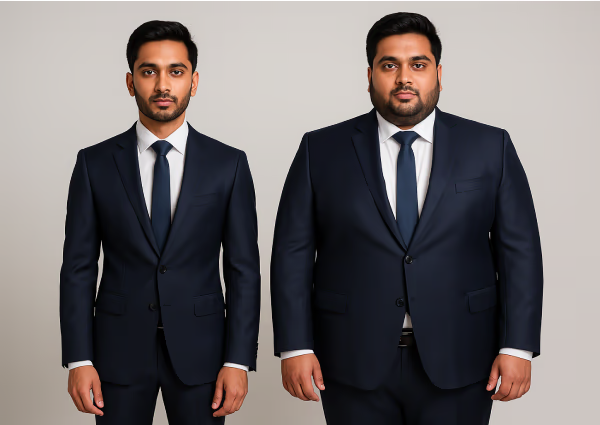
Fashion is always about expression. But over the years, fashion has been constructed on a narrow concept of what an “standard” body is.
Thankfully, the fashion industry is evolving. The emergence of plus-size fashion isn’t a flimsy trend — it’s a major shift which is changing the way clothing is created, manufactured and sold.
Let’s look into the details.
1. What do we mean by “Standard Size” and “Plus Size”?
Before we dive into the technical aspects of design, let’s review the fundamentals.
Standard Size Clothing
“Standard size” (sometimes known as straight size) is the term used to describe clothes made for the most popular size range – typically XS-XL or between 0-14 (US). This clothing items are made to accommodate typical proportions, based upon long-standing data gathered mostly from body types with slimmer proportions.
The are considered to be the “default” best-fit design for the majority of brandsbut that’s fast changing.
Plus Size Clothing
“Plus size” refers to clothes designed specifically for larger, curvier body kinds generally starting at one size or 1X (US) and extending up to 6X or 32W.
But here’s the main difference: plus size isn’t only a scaled-up version of clothing.
It’s it’s a entirely separate design method with various proportions, construction and design techniques that flatter curvier, more large shapes.
2. How do Body Proportions differ
Human bodies don’t develop equally as it grows in size.
This is why merely enlarging an existing design from size 8 up to 20 won’t make sense. The result will look a bit awkward and be uncomfortable.
Designers should instead be able to be aware of variations in curvature, shape and the ratio.
| Measurement Zone | Standard Size to Fit | Plus Size Fit |
|---|---|---|
| Bust-to-Waist Ratio | Moderate difference | Bigger bust, smaller and wider torso, with a higher waistline |
| Waist-to-Hip Ratio | Equal proportion | A flatter waistline, fuller hips |
| Shoulder Slope | Straight, narrow | A little wider, sloped slightly differently |
| Upper Arm | Slimer fit | Greater ease in bicep, and underarm |
| Hips and Thighs | Slim cut | The curvaceous fit is complemented by extra ease for mobility |
Example:
If you purchase an 8-size dress and then increase it by 30percent and it doesn’t necessarily fit a body of size 20 in the right way, due to the fact that bust the waist, hips and shoulder sizes grow at different rate.
Plus-size fashion is the reason why it uses patterns that are different completely.
3. The Pattern-Making Difference
The art of pattern-making is where wonder (and science) occurs.
Standard Size Patterns
A majority of companies design their designs with a model that fits around sizes 6 and 8. (US). This pattern then gets gradated upwards and downwards to cover the entire size range. Every size is progressively larger across all directionsthis is known as linear Grading.
Although this technique works well in small jumps of size (e.g. 6 to 10) however, it becomes unsustainable when you get to sizes beyond 16.
Plus Size Patterns
Plus-sized clothes begin with a completely distinct base pattern that is usually designed around an 18-20 size design.
Instead of even increments, patternmakers employ curving grade rules which allow for extra space in high stress zones (bust and upper arm thigh) and changing the silhouette of the lines of the garment.
The clothing is able to fit perfectly, drapes smoothly, and doesn’t sag the design.
4. The Fit Philosophy: Comfort Meets Confidence
At its core Plus-size style isn’t just about size, it’s about fitting that is a celebration of your body.
| Fit Element | Standard Size | Plus Size |
|---|---|---|
| Fit Goal | The body is slim and streamlined. | Supportive, flowing, body-positive |
| Silhouette | Straight or structure-based | A little looser in the midsection |
| Ease Allowance | Minimal | Greater ease of movement and ease of movement |
| Armholes and Necklines | Narrower | Wider curves to keep from the gap or pulling |
| Length Adjustments | Standard | The hems or bodices should be slightly longer to ensure a balanced proportion |
While a dress of standard size can be a great example of the sharpness of tailoring, a larger version is more comfortable without cutting corners or compromising style.
5. Fabric Selections and Construction Specifics
Fabric plays an important impact on how a clothing is shaped and feels and fits, especially in sizes.
In Standard Sizing
Designers usually make use of fabrics that are able to are able to hold their shape or drape beautifully such as crepe, cotton poplin or lighter wool.
These fabrics are a great way to flatter slim silhouettes and emphasize structure.
In Plus Sizing
The importance of comfort and flexibility is paramount. Designers typically choose fabrics that have flexibility, stretch and recovery for example:
-
Stretch cotton blends
-
Jersey knits
-
Ponte fabric
-
Crepe or soft viscose
-
Lightweight wool and spandex
The reinforcements and seams can be different for clothing that is larger. Plus-size clothes use reinforced stitching and larger waistbands as well as the double stitching to avoid stress at the points of stress.
This is engineering disguised as fashion.
6. Real Body Testing and Fit Models Body Testing
The fashion industry traditionally was based on one or two “sample size” model sizes (size 6- 8).
However this method leaves out an enormous portion of the real customers.
Modern brands use specially designed plus-size models usually 18-20 inches for ensuring that the final product is made to realistic proportions and not just a re-scaled math.
This makes clothing appear much more comfortable and flatteringthey are that is, they are not sagging in one spot or too loose in a different.
7. Pattern Grading & Sizing Systems
Let’s take a look at how the size-grading system differs across the world.
| Region | Standard Size Standard Size | Plus Size Range |
|---|---|---|
| US | 0-14 | 16W-32W |
| UK | 4-16 | 18-32 |
| EU | 32-44 | 46-60 |
| India | XS-XL | XXL-7XL |
| Alpha Sizing | XS-XL | 1X-6X |
“W” or the “W” of 16W or 18W is “Women’s”, which means plus-sized proportions (broader shoulders, larger busts and torsos that are adjusted).
In the standard size-grading system the jumps are approximately one inch at the hips and bust and hips; however, in size plus the jump increases in size to 1.5-2 inches to allow for natural body variation.
8. Design Philosophy: Empowerment and Representation
The most significant difference between plus-size and standard design is the mindset.
In normal sizing the focus is usually on style and shape.
In plus-size fashion, the focus is on balance, confidence as well as the body.
The Standard Size Design Preferences
-
Trend-forward silhouettes
-
Straight cuts, slim lines
-
The emphasis is on a minimum volume
Plus Size Design Priorities
-
Definition of waist and proportional of balance
-
The art of draping and fabric placement
-
Prints that extend the frame
-
Mobility and comfort without sacrificing style
A well-designed plus-size dress is naturally flattering and doesn’t feel “adjusted.”
9. Market Trends The rise of size Inclusivity
The fashion industry in the world is finally accepting the diversity of bodies.
According to reports on the market the plus-size category is now responsible for almost 20% all apparel sales across the globe and is increasing more quickly than any other type of fashion.
Brands such as Good American, ASOS Curve, Universal Standard, and Savage X Fenty have redefined the definition of inclusivity and have proven that there is no limit to style.
Even luxury houses such as Gucci, Balenciaga as well as Prabal Gurung have expanded their collections.
This change isn’t only about numbers, it’s all about being represented.
When women of all shapes and sizes see themselves in advertisements and on runways, it shifts fashion from being exclusive to becoming empowering.
10. Style and Silhouette Variations
| Category | Standard Sizes | Plus Size Styles |
|---|---|---|
| Dresses | Bodycon, sheath, A-line | Empire waist Wrap, fit-andflare |
| Tops | Cropped, boxy, fitted | Tunic-length, peplum, belted |
| Pants | Slim fits, straight cuts | Mid-rise, elasticized rear, large-leg |
| Outerwear | Jackets with structure | Waterfall coats and designed cardigans |
| Formalwear | Strapless dresses | Off-shoulder, V-neck or V-neck for the balance of your bust |
The aim isn’t to hide lines, but rather to keep the nature’s shape.
11. It’s the Technical Part: Construction and Balance
What many do not realize: larger clothing items require the use of engineering.
-
The reinforced seams are designed to manage tension points
-
Deeper darts for bust shaping
-
Wristbands with curvature to stop rolling
-
Bias-cut panels for graceful draping
-
Zippers with a greater thickness and linings to increase safety
In regular size clothing the emphasis is on silhouette and form.
In plus size, each stitch serves an important purpose: the comfort of support as well as confidence.
12. Fabric & Print Strategy
In the fashion of larger sizes, fabric patterns and prints are more important than ever before.
-
Smaller-scale and vertical lines prints extend the body visually.
-
Fabrics that stretch or blend provide a more rounded contour.
-
Dark, dark bases with bright overlays give movement and create contrast.
Furthermore, standard sizing permits bolder prints and lighter materials with no visual distortion.
Both depend on the harmony of fabric and fit.
13. What is the significance of plus size fashion?
Plus-size clothing isn’t merely a fashion statement it’s a declaration that every person deserves style.
For decades, fashion was a barrier to sizes that went beyond the size of XL.
Now, inclusion means that nobody is going to be uncomfortable or unwelcome wearing what they are wearing.
If a woman can find clothes that are actually sized to will fit her hips and waist, without gaps or a blazer that can be adjusted to her shouldersit’s more than just the mere appearance of a piece.
That’s self-expression returned.